Madison Tree Removal Pros provides crane tree removal in Madison, AL for the jobs where climbing and rigging alone would put too much load, or too much risk, over something that matters. Twenty years of doing both means we know which is which, and the honest answer is that most trees do not need a crane. The ones that do, need it badly.
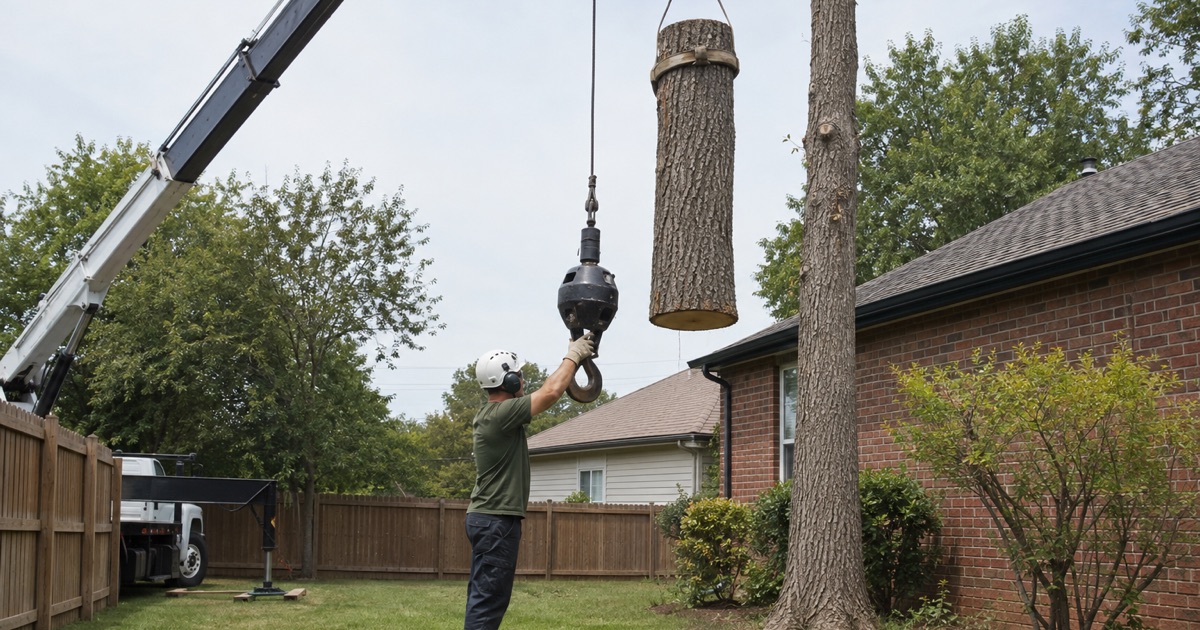
What a crane buys is control of the piece before the cut is finished. In conventional dismantling a section is lowered under friction after it is severed, so for a fraction of a second the rigging has to catch it. On a crane pick the load is already supported when the cut goes through, and it never travels anywhere it was not intended to go.
That matters most over a roof, a pool, a screened porch or a neighbor’s fence, and it matters just as much on a stem too decayed to be climbed safely. The tree that most needs taking down is frequently the one least suited to carrying a climber, and a crane resolves that contradiction without asking anyone to gamble on how much sound wood is left.
When a Crane Is the Right Answer
Trees Over Roofs, Pools and Structures
A large tree standing over a house has no drop zone and often no rigging point clear of the structure. Picking sections off with a crane and swinging them to the street removes the whole problem, and it removes it before the cut rather than after. Pools, screened enclosures and conservatories get the same treatment, since none of them tolerates even a controlled brush.
Dead and Decayed Stems Nobody Should Climb
A stem with a decay column, a root flare conk or extensive hypoxylon is not a structure anybody should attach a climbing line to, and no amount of experience makes it one. Working it from a crane basket or picking it in sections with the climber never loading the stem is how those trees come down. Refusing to climb a rotten tree is a policy, not a preference.
Confined Yards With No Drop Zone
Many newer subdivisions around Madison put substantial trees on lots with no clear area at all, where every direction contains a fence, a shed, a neighbor’s roof or a play set. Reaching over the house from the street solves it. So does a spider lift where a crane cannot see the tree, and the estimate says which one your yard supports.
How a Crane Removal Runs
Setup, Outriggers and Ground Bearing
Setup is most of the job. The machine has to sit on ground that will carry it, with outriggers fully extended onto pads sized for the load, clear of septic fields, buried lines and unknown concrete. Getting that right is what keeps a driveway intact and the machine level, and it is decided when we quote the job rather than improvised on the morning.
Pick Weights, Load Charts and the Working Load Limit
Every pick is planned as a weight at a radius, checked against the machine’s load chart, with the rigging chosen inside a stated working load limit. Green wood is much heavier than people estimate, and a limb full of water after a wet week is heavier again. Sections get sized to the chart, which is why a crane day proceeds in a rhythm rather than in bursts.
The Climber, the Pick and the Cut Sequence
The climber sets the sling, the crane takes the weight, and only then does the cut go through — in that order, every time. Each section is picked, swung to the landing zone, and released to the ground crew for processing while the climber is setting the next one. The sequence is what makes a crane removal fast: nothing waits on anything else.
What Sets Up a Crane Day Here
Street Access, Cul-de-Sacs and the Neighbors
A crane needs road width, a clear approach and somewhere for the chip truck and the log truck to sit. In a cul-de-sac or on a narrow subdivision street that means talking to neighbors in advance about parking and brief access interruptions. We would rather knock on three doors the week before than block a driveway unannounced and spend the morning apologizing.
Overhead Lines and the Disconnect That Comes First
Nothing swings until the electrical situation is settled. The pole-to-house service drop is the customer’s responsibility according to Huntsville Utilities, so we arrange that disconnect; the primary conductors are the utility’s own work. Which utility that is depends on the county line — Huntsville Utilities on the Madison County side, Athens Utilities on the Limestone side — and that call is made well before the crane is booked.
Ground Protection for Drives, Lawns and Beds
Outrigger pads, cribbing and track matting are not optional extras, they are what stops the removal costing you a driveway. Where a machine or a grapple truck has to cross turf, matting goes down first, and where it cannot, the material gets carried. We tell you which surfaces we intend to occupy and what protection is going on them before anyone arrives.
When a Crane Will Not Fit
Tracked Spider Lifts Through a Side Gate
A tracked spider lift walks through a standard side gate, sets its own outriggers in a small footprint and puts an operator into the canopy without anyone climbing the stem. On fenced back-yard trees in this ring it does what a crane cannot, and it marks a lawn far less than any wheeled machine of comparable reach.
Knuckleboom Grapple Trucks for the Load-Out
Much of a crane day’s efficiency is in clearing the landing zone as fast as sections arrive. A knuckleboom grapple truck lifts whole sections from the street straight into the bed without hand loading, which keeps the crane cycling. On big removals the load-out equipment, not the crane, is often what decides whether the job finishes in a day.
Sectional Dismantling and Speed Line Rigging
Where neither machine can be positioned, the work goes back to conventional dismantling: sections lowered on a bull rope through a rigging block with a Port-a-Wrap at the base, or moved sideways out of a confined area on a speed line. It is slower and it is well within what a trained crew does routinely, and the quote reflects the extra hours honestly.
- 20+ Years in the Tennessee Valley
- Free Written Estimates
- Crane and Narrow-Access Equipment