Madison Tree Removal Pros approaches tree disease treatment in Madison, AL by establishing the cause before recommending anything, which sounds obvious and is not how most declining trees get handled. More than twenty years of working on trees in the Tennessee Valley has produced one consistent finding: the majority of trees we are called to look at as diseased are not diseased. They are injured, buried, compacted or thirsty.
That distinction is worth money to you, because the treatments are completely different and only one of them is cheap. A pathogen may or may not be treatable. A root flare buried under eight inches of grade from a landscaping job, a root plate cut through for a driveway, or a soil so compacted that water sheets off it are all correctable, and correcting them costs less than a removal.
So this page is mostly about diagnosis. What we can tell you from an inspection is what the evidence supports, what it rules out, and which of the treatable causes is worth trying first. Where the answer really is a pest or a decay fungus, we will say what it is, whether the tree is structurally finished, and what your options actually are rather than which product we would like to sell.
Diagnosis Before Treatment
The Non-Living Causes That Look Like Disease
Drought, fill soil over the root zone, compaction from equipment or parking, salt, herbicide drift and physical root severance produce sparse crowns, small leaves, early color and dieback — the entire symptom set people associate with infection. These abiotic causes are more common in a settled subdivision than any pathogen, and they leave evidence in the soil and at the flare rather than in the canopy.
Root Flare Problems Read as Decline
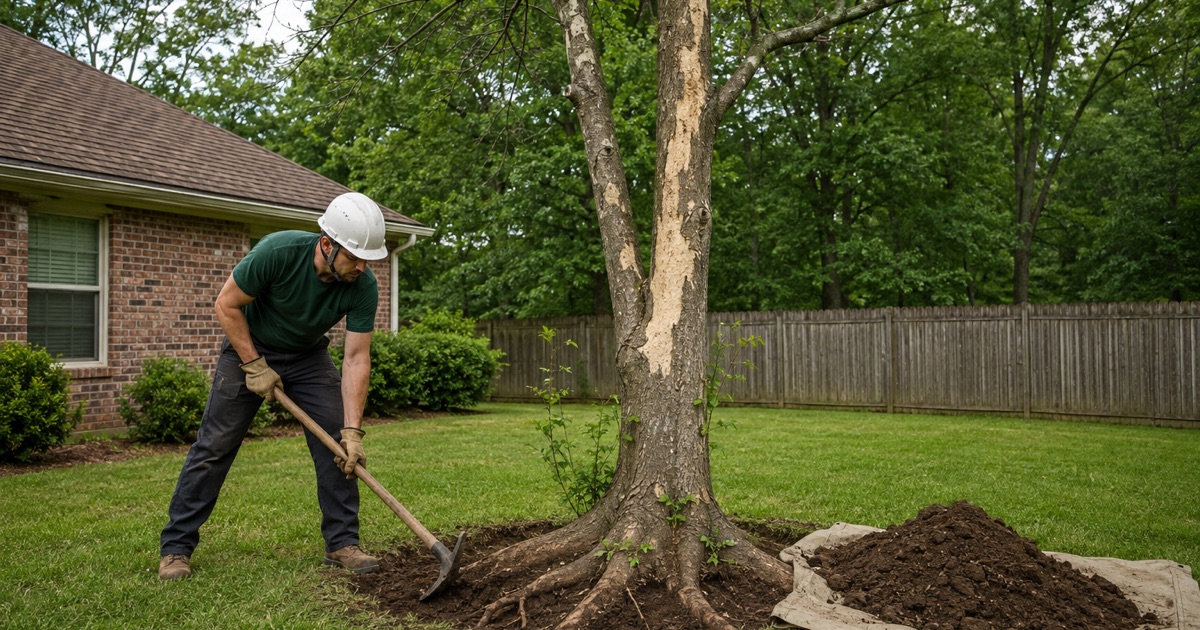
A trunk that enters the ground like a post rather than flaring is buried, girdled, or both, and that single observation explains a great many mystery declines. Girdling roots wrap the stem and slowly strangle the vascular tissue on one side, which is why the dieback is often on one side of the crown. An air-excavation device exposes the collar without tearing roots, so the finding can actually be made.
Why the Crown Changes Last
A tree spends stored reserves keeping its canopy up long after the root system is in trouble, so by the time the crown looks bad the problem is several seasons old. That lag is why annual inspection of a significant tree is worth more than a reaction to a bad-looking summer, and why the useful diagnostic question is what changed in the root zone three to five years ago.
The Pests This Valley Actually Has
Emerald Ash Borer, Confirmed in Madison County
The Alabama Forestry Commission confirmed emerald ash borer in Madison and Jackson counties on June 6, 2025, its first confirmed detection in either. Its forest health coordinator notes that damage usually begins at the top of the crown and proceeds downward, so a thinning upper canopy on an ash here is a specific finding rather than general decline. Felled infested ash is best burned or destroyed on site.
Southern Pine Beetle and Ips Engraver Beetles
The Alabama Forestry Commission names southern pine beetle the number one killer of pines in the state, with unmanaged loblolly and shortleaf stands the susceptible ones. The trap is diagnostic: in drought the pitch tubes may be very small or entirely absent. Ips engraver beetles leave their own gallery pattern under the bark and typically follow stress rather than starting it.
Borers on Sugarberry and Other Stressed Hardwoods
Flatheaded borers, including the one that works on hackberry and sugarberry, leave D-shaped exit holes and are overwhelmingly secondary — they colonize trees already weakened by drought or root damage. That is useful information rather than a footnote, because it redirects the question from what insecticide to what happened to this tree’s roots, which is where the recoverable answer usually lives.
Diseases and Decay Fungi
Hypoxylon Canker on Stressed Hardwoods
Hypoxylon appears as bark sloughing away from patches of hard, dark, crusted fungal tissue on oaks and other hardwoods under sustained stress. It is not a pathogen that attacks healthy trees; it is what finishes ones already compromised by drought or root loss. Once it is extensive on a main stem the tree is structurally unreliable, and the honest conversation is about targets rather than treatment.
Seiridium Canker in Leyland Cypress Screens
A Leyland cypress row planted on hedge spacing grows into competing full-size trees, and that stress is what lets Seiridium canker move through the row. It shows as individual browning stems with sunken, resinous cankers rather than as an even decline. Pruning out cankered wood slows it; where more than a third of the screen has gone, replanting with mixed species is usually the better spend.
Bracket Fungus, Conks and Structural Decay
A fruiting body is the visible end of decay that started years earlier inside the wood. On the trunk it indicates a decay column extending above and below. At the root flare it is more serious, because that is the wood carrying every load the tree experiences. We locate and measure them against stem diameter and photograph them, so the question becomes how much sound wood remains.
Soil, Roots and Trees Worth Recovering
Root Collar Excavation and Girdling Roots
Excavating the collar with compressed air exposes the flare without damaging fine roots, and it routinely finds the answer: fill over the flare, a girdling root, or decay that was invisible from above. Cutting a girdling root is a real intervention with a real recovery, and it is the treatment most often missed because nobody looked below the mulch.
Radial Trenching, Vertical Mulching and Decompaction
Compacted soil has lost the pore space roots need for air and water, and no fertilizer fixes that. Radial trenching, vertical mulching and air decompaction restore structure across the root zone and let amended material in. On a mature tree in a lawn that has been driven on or built around, this is frequently the whole treatment plan.
Mulch, Water and the Unglamorous Things That Work
A wide, thin mulch ring that never touches the trunk, deep and infrequent watering through drought, and an absolute end to further root zone injury will do more for most stressed trees here than anything sold in a bottle. We say so even though it is not billable work, because a treatment plan that ignores the basics is a plan that gets to repeat itself.
- 20+ Years in the Tennessee Valley
- Free Written Estimates
- Crane and Narrow-Access Equipment