Madison Tree Removal Pros handles tree trimming and pruning in Madison, AL, serving surrounding cities including Huntsville, Redstone Arsenal, Triana, Harvest and Athens, with more than twenty years of climbing and rigging work behind the crews. The thing that separates a good pruning job from an expensive haircut is not equipment. It is deciding, before anyone leaves the ground, exactly which cuts are being made and why.
So every trimming job here starts with a named objective written on the work order. ANSI A300, the industry’s tree care standard, defines pruning by purpose rather than by amount, and “take it back a bit” is not a purpose. When the customer asked for roof clearance and the crew heard thin it out, both parties are disappointed at the same moment, and that gap is entirely preventable in a two-minute conversation at the estimate.
The other half of the job is knowing the tree in front of you. A water oak, a silver maple, a Bradford pear and a row of Leyland cypress in the same subdivision want four different interventions on four different timelines, and treating them as one line item called trimming is how a yard ends up with one dead screen and one tree topped for no reason.
The Four ANSI A300 Pruning Objectives
Crown Cleaning for Deadwood and Hangers
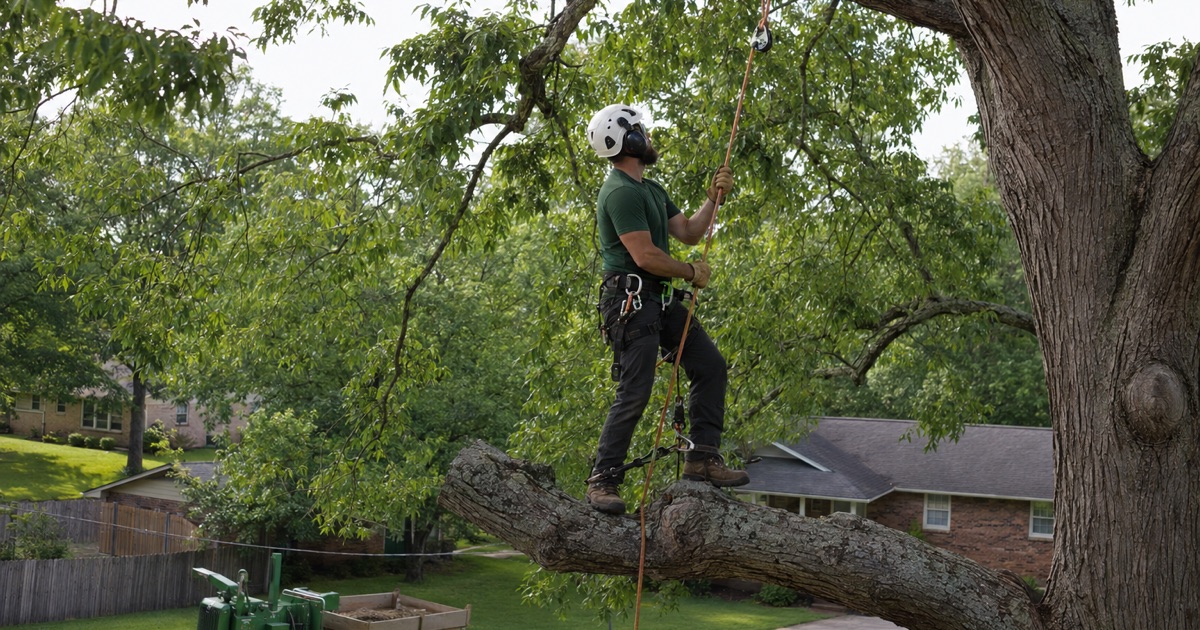
Cleaning takes out dead, dying, diseased and broken wood along with any hanger a previous storm left in the canopy, and touches nothing that is alive and sound. It is the lowest-risk pruning there is and usually the highest-value, because deadwood is what actually falls on cars and patios between storms. On a large shade tree it is often the whole job, and we will say so rather than upselling past it.
Crown Raising Over Roofs, Drives and Walkways
Raising removes the lowest limbs to create clearance under the canopy — over a roof, a driveway, a sidewalk or a mower line. The discipline is in stopping: a crown lifted too far leaves a tall stem carrying all its weight up high, which is worse in wind and looks wrong for decades. We raise to the clearance you actually need and record that height, rather than to whatever the pole saw could reach.
Crown Reduction Back to Live Laterals
Reduction is how a tree gets genuinely smaller without being ruined. Each cut goes back to a living lateral branch big enough to assume the terminal role, so the wound closes and the growth that follows is attached to real wood rather than to a stub. It is slower and more skilled than topping, which is precisely why the cheap quote in your inbox is not offering it.
Crown Thinning and What It Will Not Fix
Thinning selectively removes interior branches to increase light and air movement through a canopy. Done lightly it helps a crowded crown; done heavily it strips interior foliage, pushes all the weight to the branch tips and leaves previously shaded bark exposed to sun. Thinning is also not a wind remedy, and asking for a tree to be opened up so wind passes through is a request we will talk you out of.
Pruning by Species in the Tennessee Valley
Water Oak, Willow Oak and Chronic Deadwood
Water oak grows fast, shades a yard beautifully and starts shedding interior deadwood far earlier in its life than the white oaks planted beside it. Owners often read the first deadwood as disease when it is age and habit. A cleaning cycle keeps it safe and buys years; what it will not do is turn a tree already past its structural prime into a young one.
Silver Maple, Bradford Pear and the Included-Bark Union
Both species habitually form co-dominant stems with bark folded into the union instead of wood, and that union is the failure point in a spring storm rather than the trunk or the roots. Pruning end-weight off the leaders helps. Where the crack has already started, the honest options are a cabling system or a planned removal, and we would rather have that conversation in March than after the fact.
Leyland Cypress Screens and Seiridium Canker
A Leyland row planted for privacy on hedge spacing grows into a line of full-size trees with shallow root plates, competing for the same water. Under that stress Seiridium canker moves through the row and browns whole stems from the inside. Pruning out cankered wood buys time and slows spread; it does not cure the row, and a screen more than a third gone is usually a replanting decision.
What We Will Not Do to a Tree
Topping, Lion-Tailing and the Recurring Bill
Topping and its cousin lion-tailing — stripping interior growth and leaving a tuft at the branch end — both produce a tree that looks trimmed and behaves worse. Epicormic sprouts flush from the outer wood, weakly attached and growing fast, so the crown returns heavier than before on a stem now decaying from every stub. The bill returns with it, every two or three years.
Flush Cuts and the Branch Collar
A branch removed flush with the trunk cuts through the collar, which is the tissue that closes the wound and walls off decay. It looks tidier for one season and leaves a decay column for the rest of the tree’s life. Our cuts are made just outside the collar, and on anything of weight they are made in three stages so the limb cannot tear bark on the way down.
Over-Thinning and Sunscald on Exposed Bark
Bark that has been shaded for thirty years is not equipped for direct afternoon sun, and an aggressively thinned crown exposes exactly that on the upper surfaces of major limbs. The damage shows up as cracked, sloughing bark a season later, well after anyone connects it to the pruning. Restraint is a technique, and on a mature tree it is most of the job.
Timing, Clearance and the Wires Overhead
When to Prune and When to Wait
Structural work is easiest in the dormant season, when the framework is visible and there is no foliage weight to misread. Deadwood and storm hazards do not wait for a season. Two timing rules are worth keeping in this area: oaks are better left alone during the spring flush, and pines are better handled outside the peak flight period for bark beetles.
Service Drops, Line Clearance and Who Owns the Cut
The wire from the pole to your house is a service drop, and Huntsville Utilities states plainly that clearing trees off customer service wires rests entirely with the customer. The primary conductors above it belong to the utility and are pruned by its own line clearance program. We identify which wire your limb is over first, then arrange the disconnect if the work is ours to do.
Sight Triangles, Street Frontage and City Rules
Madison’s zoning ordinance requires clear visibility at intersections and driveways to be maintained in the band between three and a half and eight feet above the surface, and sets street tree spacing along arterial and collector frontage. If a limb or a shrub mass is what is blocking the view from your drive, raising the crown to clear that band is a specific, checkable objective rather than a vague request to tidy things up.
- 20+ Years in the Tennessee Valley
- Free Written Estimates
- Crane and Narrow-Access Equipment